CLICK HERE FOR FREE BLOGGER TEMPLATES, LINK BUTTONS AND MORE! »
Showing posts with label vocabulary. Show all posts

Wednesday, July 24, 2013

Multiple Uses of Name Badge Holders

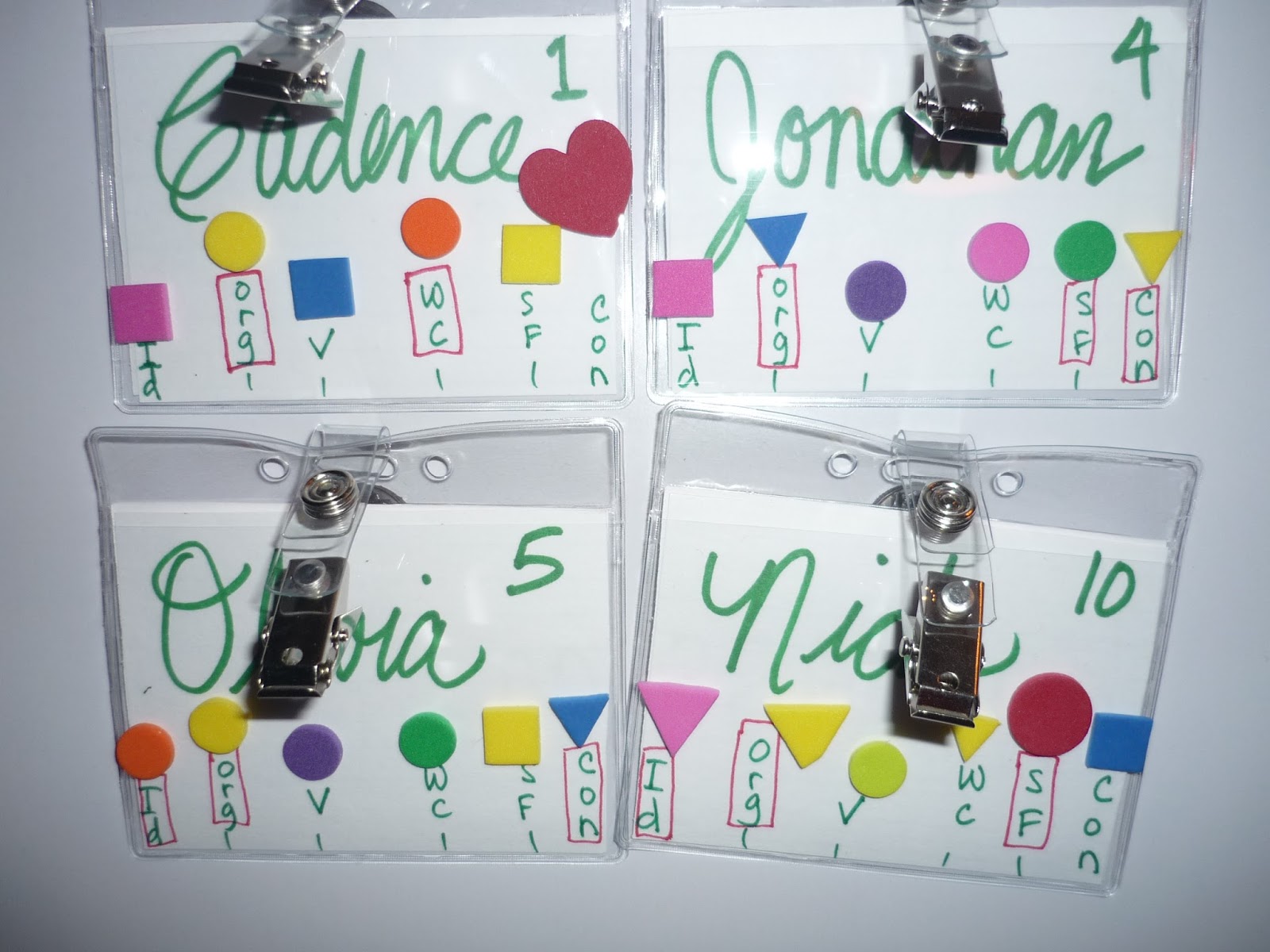
This summer one of my professional reading books was Word Nerds by Overturf, Montgomery, and Holmes-Smith.  In the book they suggested the use of inexpensive badge holders to assign each student a vocabulary word to practice activities throughout the day.  As I purchased the badge holders, I got to thinking how I could make this tool work in other areas.  Here's my plans for next year:

1.  Attendance and Lunch Count
     I glued a magnet to the back of the holder.  Students will move their badge from the absent section to their lunch choice each day as an easy way to take attendance and take lunch count.

2.  Peer Editing Based on Writing Goals and Levels of Proficiency
     Writing is right after recess in my classroom.  When they come in, they will take their badge holder off the attendance board and clip it on with their name showing.  Below their name, each child has the Six Traits of writing.  Their personal goals are boxed in red. Nick's goals are in Ideas, Organization, and Sentence Fluency. Their present level of proficiency is represented by a shape:  triangle for level 1, circle for level 2, square for level 3, and heart for level 4.  Seeing these shapes will give students daily reminders of their goal areas.  If students move up a proficiency level during the year, I will change the foam sticker. 
     In my classroom, students can only be a peer editor in an area where they are at a higher profiency level than the peer they are editing with. So, for example, Nick has a level 2 in Sentence Fluency.  He can be a peer editor for a student with level 1 in Sentence Fluency. The badge will let all students know where they stand visually.
     But, you might say, Nick has a goal to improve in that area.  All the better.  As Nick helps other students, he will become stronger and practice that skill.  As teachers, we all know how much we learn when we have to teach others.
       Below is the start of a poster that explains the four levels.  This will go on my "Writer's Block" bulletin board and goes with my classroom colors of chalkboard green, black, and ladybug red.

3.  Vocabulary Practice
     Right after Writing is ELA, which consists of English grammar, spelling, and vocabulary.  Students will turn their names around to become vocabulary words for this instruction.  In the picture you can see the magnets I attached to the back for attendance.  I think I will make a nice and quick, but meaningful, transition from Writing to ELA, which occurs back-to-back in the same literacy block.
     Students will use the vocabulary words in many hands-on and creative ways.  They can line up by definition, in alphabetical order, group themselves by parts of speech, roots, or affixes.  Throughout the week, students will be adding synonyms and antonyms to the 5 core words for the week.  Students can pair with their synonym or antonym and decide which is "stronger" and why.  They can us the vocabulary cards for charades and creating oral sentences, which the authors of Word Nerds call 7-Up sentences because they need to have seven words or more. Students can create or find on the Web images to illustrate their word.  For an even greater challenge, students can find a single color that represents the word.

Saturday, May 11, 2013

Meeting the Needs of Advanced Students

     As much as I love Daily Five, I do miss the guided reading groups from the past.  I felt I accomplished a lot when I got to see two or three groups each day.  There are times that I would like to meet with more than one group, but I haven't been able to get my head around how I could make that happen.  That is until I purchased this new book by Evan-Moor:
 (This book comes in several different grade levels.  
Click HERE and it will take you to Amazon for more information.)

     I am a big fan of Evan-Moor's learning game books.  They have books for Reading, Vocabulary, Science, Writing, Math, and Geography.  All the materials are in full color and ready to use, which makes the games extremely quick and easy to put together.  They are also one of the few publishers that have learning games for the upper elementary grades.  
     In addition to the learning games in this book, it has answer keys and, most importantly, short assessments for each game.  It was the assessments that really got me thinking.  My advanced students are very hard-working and conscientious.  They are willing and capable of playing a game independently, but just having them play a game unsupervised does not hold them accountable enough.  So, using this resource, I decided to assign them a game each day, have them complete the matching assessment, and check themselves using the answer key.  The short assessments will keep them accountable for learning and the self-checking component will make it less work for me. :)
     The end of the year is a great time to try out new strategies that you may want to adopt for the entire year next year.  It's especially important during the "doldrums" after high-stakes testing to keep students motivated for the rest of the year.  Changing things up a bit can breathe new life into you students.  
     What kinds of things are YOU trying out in the last few weeks of the year?  How do you use learning games in you classroom?  How do you keep students accountable for information learned through game play?  I'd love to hear from you!

Saturday, March 30, 2013

Hollywood Squares Review Game

I was looking through my teacher files this week to try to come up with a fun games for my kids.  It is still cold with lots of snow on the ground here in northern New England.  Although Easter is around the corner, spring hasn't sprung yet.  The kids are pretty anxious for that to happen.  When it gets above freezing they try to ditch their winter coats.  I know many of you are starting "test prep" season.  Our high stakes test is in October, so I don't have to worry about that until the start of school.  So maybe a fun game is good for all of us. :)
One of my favorites is Hollywood Squares.  It combines two things kids love:  competition and whiteboards.  You can use this game to review anything, but it is particularly good for vocabulary,spelling and math computation because the answers will be short enough to write quickly on a whiteboard.  Set up the front of your room with three student desks in a row and three chairs in front of them.  Lay one whiteboard, marker and eraser on each desk, chair, and one in front of each chair.  Having one child sit on each desk, one in each chair, and one on the floor in front of each chair gives you a three by three tic-tac-toe board.
Divide the rest of the class into two teams:  X and O.  Usually I do boys verses girls, just like Hollywood Squares.  The teams take turns picking a person holding a whiteboard.  I ask the question and the person with the whiteboard writes their answer and shows it.  Now, here's the great part.  The person with the whiteboard doesn't have to get the answer correct.  The person who picked them has to decide if the answer is right or wrong.  If they choose correctly, they "take" the square.  If not, the other team gets it.  Just like tic-tac-toe, the object is to get three in a row. 
My students love this game, and I hope yours will, too.

Sunday, June 3, 2012

Summer time is a great time to create learning games.  This is a vocabulary review game I made with a file folder and those cute and colorful letters you can buy to make posters.  Students decide on what they are going to do before playing.  Students can review vocabulary from any unit.  Kids start by putting their piece on any letter.  Then they roll the die to move.  When they land on a letter, they say a vocabulary word that begins with that letter and give the definition.  This is also a fun game to practice similes.  When students land on a letter, they create a simile using an animal that begins with that letter.
 as loud as an alley cat
as blind as a bat
as squishy as a caterpillar